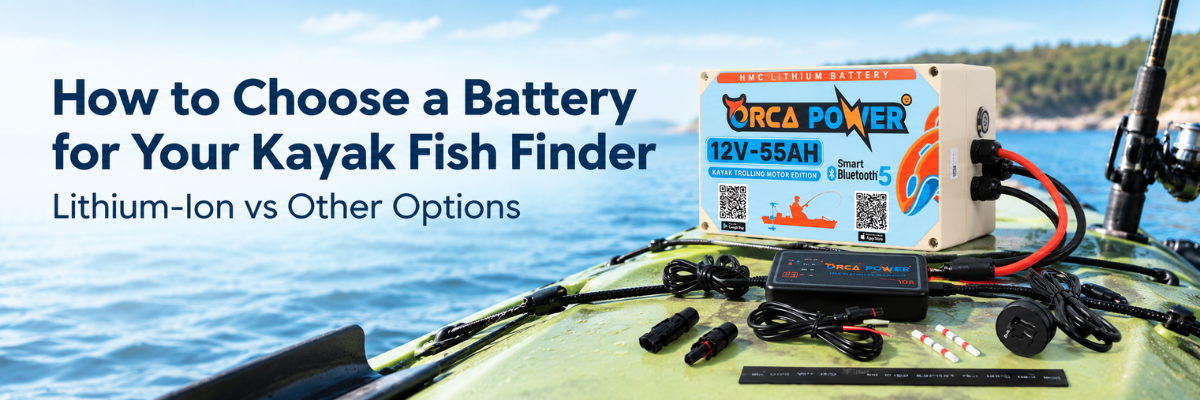
How to Choose a Battery for Your Kayak Fish Finder: Lithium-Ion vs Other Options
A fish finder is one of the most useful pieces of technology on a modern fishing kayak. It can help anglers understand water depth, locate underwater structure, identify fish and make better decisions while moving around the water.
But a fish finder is only useful when it has a reliable power source.
Choosing a battery for a kayak fish finder is slightly different from choosing a battery for a trolling motor. A fish finder typically consumes much less power, so a large-capacity battery designed for running an electric motor may be unnecessary for anglers who only need to power their electronics.
For many kayak anglers, a compact Lithium Battery in the 30Ah or 50Ah range can provide a practical balance between runtime, weight and portability.
This guide explains what to look for when choosing a battery for your fish finder and how lithium-ion compares with other battery options.
Why Does a Fish Finder Need a Dedicated Battery?
Most fish finders require a stable DC power source. While some kayak setups may have multiple electrical devices connected to one battery, many anglers prefer using a dedicated battery for their fish finder and electronics.
A separate battery can help keep the setup simple and reduce the chance of other equipment using the available power.
Depending on the setup, the battery may be used for:
- Fish finders
- GPS units
- Navigation lights
- Fishing lights
- USB accessories
- Cameras and other small electronics
If your kayak also has a trolling motor, however, it is worth considering a separate, higher-capacity battery specifically designed for the motor.
How Much Battery Capacity Does a Fish Finder Need?
One of the biggest mistakes anglers can make is assuming that a larger battery is always better.
Fish finders generally use considerably less power than electric trolling motors. Because of this, a 30Ah or 50Ah battery can be a much more practical choice for powering a fish finder and other smaller electronics.
The right capacity depends on:
- Your fish finder's power consumption
- How many hours you normally fish
- Whether other electronics share the battery
- Your kayak's available storage space
- How much weight you want to carry
Before buying a battery, check the power requirements of your particular fish finder and estimate how long you expect to use it during a typical trip.
30Ah vs 50Ah Lithium Battery for a Fish Finder
For many kayak fishing setups, the choice may come down to a 30Ah or 50Ah Lithium Battery.
30Ah Lithium Battery
A 30Ah battery can be a good option for anglers who primarily need to power a fish finder.
Its smaller capacity can provide several practical benefits:
- Lower overall weight
- Easier transportation
- Smaller physical footprint
- Easier installation in compact kayak compartments
- Sufficient capacity for many electronics-only setups
If you normally fish for a few hours and only operate a fish finder and small accessories, a 30Ah battery may be all you need.
50Ah Lithium Battery
A 50Ah battery provides additional capacity and can be a better choice for anglers who spend longer periods on the water or run multiple electronic accessories.
It can be useful when your setup includes a fish finder along with devices such as GPS equipment, lights or other low-power electronics.
The additional capacity also provides more reserve for longer fishing sessions.
For anglers who want more flexibility without moving to the much larger capacity associated with trolling-motor batteries, a 50Ah lithium battery can be a useful middle ground.
What About a 100Ah Battery?
A 100Ah battery is a very different proposition.
While a 100Ah battery offers substantially more capacity, it is generally more than a fish finder alone needs. Batteries in this capacity range are much more relevant to higher-power applications, such as kayak trolling motors, where the motor can draw significantly more current.
Using a 100Ah battery purely to run a small fish finder can add unnecessary weight, take up valuable storage space and increase the overall size of the electrical setup.
For a fish-finder-only application, anglers should first consider whether a 30Ah or 50Ah lithium battery provides enough capacity for their needs.
A 100Ah battery can make sense when the battery is being used for a trolling motor or a larger electrical system, rather than simply powering a fish finder.
Lithium-Ion vs Other Battery Options
Once you know how much capacity you need, the next decision is battery chemistry.
Traditional lead-acid and AGM batteries have been widely used for marine and recreational applications. However, lithium-ion batteries have become increasingly popular among kayak anglers.
Lithium-Ion Batteries
Lithium batteries are particularly appealing for kayaks because weight and available space are important considerations.
A quality lithium battery can offer:
- Lower weight
- Good energy density
- Long usable runtime
- Consistent power delivery
- Compact installation
- Convenient portability
For anglers who carry their kayak from the vehicle to the water, reducing battery weight can make a noticeable difference.
A 30Ah or 50Ah lithium battery can provide a useful power solution without adding the bulk associated with much larger batteries.
AGM and Lead-Acid Batteries
AGM and other lead-acid batteries remain a familiar option for marine applications.
They can be suitable for certain kayak setups, particularly where weight is not a major concern. They are also widely available in different sizes.
However, larger lead-acid batteries can become quite heavy. This is an important consideration when the battery needs to be carried along with the kayak and fishing equipment.
For a lightweight electronics setup, lithium can therefore be an attractive alternative.
Check Your Fish Finder's Power Requirements
Before purchasing any battery, check the manufacturer's specifications for your fish finder.
Look for:
- Operating voltage
- Current draw
- Power consumption
- Recommended battery type
- Charging requirements
The power requirements vary between fish finder models, so there is no single battery size that is suitable for every angler.
For example, a compact fish finder with low power consumption may work comfortably with a smaller battery, while a larger unit with additional features may require more capacity.
It is always better to match the battery to the actual equipment rather than choosing a battery based purely on its Ah rating.
How Long Will a 30Ah or 50Ah Battery Last?
Battery runtime depends on the fish finder's actual current consumption.
As a simple example, if a device draws approximately 1 amp continuously, a 30Ah battery could theoretically provide around 30 hours of operation under ideal conditions, while a 50Ah battery could provide around 50 hours.
Real-world runtime will vary.
Factors such as screen brightness, GPS usage, sonar settings, temperature, battery condition and additional connected devices can all affect actual performance.
For this reason, anglers should always allow some reserve capacity rather than planning to completely drain the battery.
Weight Matters on a Fishing Kayak
Battery weight is particularly important for kayak fishing.
A kayak already carries your:
- Fishing rods
- Tackle
- Safety equipment
- Paddle or pedal drive
- Fish finder
- Food and water
- Other fishing accessories
Adding a large battery that you don't actually need can unnecessarily increase the total load.
This is another reason why a 30Ah or 50Ah lithium battery may be more suitable for a fish finder than a 100Ah battery.
A smaller battery can be easier to carry, position and remove from the kayak after a fishing trip.
Don't Forget Battery Size and Storage
Capacity isn't the only specification that matters.
Before purchasing a battery, measure the available space inside your kayak.
Check:
- Battery dimensions
- Weight
- Terminal position
- Cable length
- Connector compatibility
- Available storage space
The battery should be securely positioned and protected from unnecessary movement while the kayak is being transported or used on the water.
A compact battery can be particularly useful when storage space is limited.
What About Orca Power?
For anglers looking for a dedicated power solution for their kayak electronics, Orca Power offers lithium battery options designed for marine and kayak applications.
When choosing an Orca Power battery, anglers should consider the capacity that matches their intended use rather than simply choosing the largest option available.
For a fish finder and smaller electronics, a 30Ah or 50Ah battery may be a more practical choice. Larger batteries, such as 100Ah options, are better suited to higher-demand applications such as trolling motors or setups requiring substantially more power.
The key is to match the battery to the equipment.
Choosing the Right Charger
The charger is another important part of the battery setup.
Lithium batteries require a charger that is compatible with the battery chemistry and voltage. Using the correct charger helps ensure that the battery can be charged properly and safely.
When choosing a battery and charger, check:
- Battery chemistry
- Nominal voltage
- Charging voltage
- Charger output
- Connector type
- Manufacturer recommendations
Some battery packages are supplied with a compatible charger, which can make setting up your kayak power system easier.
Protect Your Battery and Connections
Kayak fishing means spending time around water, so protecting electrical equipment is important.
Keep the battery and electrical connections away from unnecessary exposure to water and spray. Connections should be properly secured and protected against moisture.
Regularly inspect:
- Battery terminals
- Cables
- Connectors
- Fuse holders
- Charging connections
- Signs of corrosion or damage
Saltwater anglers should pay particular attention to corrosion and rinse appropriate equipment after use according to the manufacturer's instructions.
Battery Management and Safety
A lithium battery's internal protection system is another important consideration.
A Battery Management System (BMS) can monitor battery operation and provide protection against certain conditions such as overcharging, over-discharging and excessive current, depending on the battery design.
When comparing lithium batteries, check what protection features are included and follow the manufacturer's instructions for installation, charging, storage and use.
The battery should also be secured properly inside the kayak rather than being left loose in a storage compartment.
Fish Finder Battery vs Trolling Motor Battery
It is useful to separate these two applications when planning your kayak's electrical system.
|
Application |
Typical Consideration |
|
Fish finder only |
30Ah may be sufficient depending on the unit |
|
Fish finder + small electronics |
30Ah–50Ah may be suitable |
|
Multiple electronics / longer sessions |
50Ah can provide additional reserve |
|
Trolling motor |
Larger capacity such as 100Ah may be appropriate |
|
Trolling motor + electronics |
Consider separate batteries or a properly designed larger system |
These are general guidelines rather than fixed requirements. Always check the power consumption and recommendations for your particular equipment.
Which Battery Is Best for Your Fish Finder?
The best battery depends on how you fish.
Choose a smaller 30Ah lithium battery if:
- You mainly power a fish finder
- You fish for shorter sessions
- Weight and portability are important
- You have limited storage space
Consider a 50Ah lithium battery if:
- You regularly spend longer days on the water
- You operate several small electronic devices
- You want additional power reserve
- You want one battery for several low-power accessories
Consider a 100Ah battery if:
- You are powering a trolling motor
- Your electrical system has substantially higher power demands
- You need considerably more capacity than an electronics-only setup
Final Thoughts
Choosing a battery for a kayak fish finder doesn't mean choosing the biggest battery available. The goal is to find the right balance between capacity, runtime, weight, size and practicality.
For many fish-finder-only kayak setups, a 30Ah or 50Ah Lithium Battery can be a more sensible option than a 100Ah battery. A 100Ah battery is generally more relevant when powering a trolling motor or other high-demand equipment.
Before buying, check your fish finder's power requirements, estimate your typical fishing time and consider what other electronics you will be running.
For anglers considering Orca Power, selecting the battery capacity based on the actual application can help create a lighter, simpler and more practical kayak power setup—leaving more room and capacity for what matters most: time on the water and time finding fish.